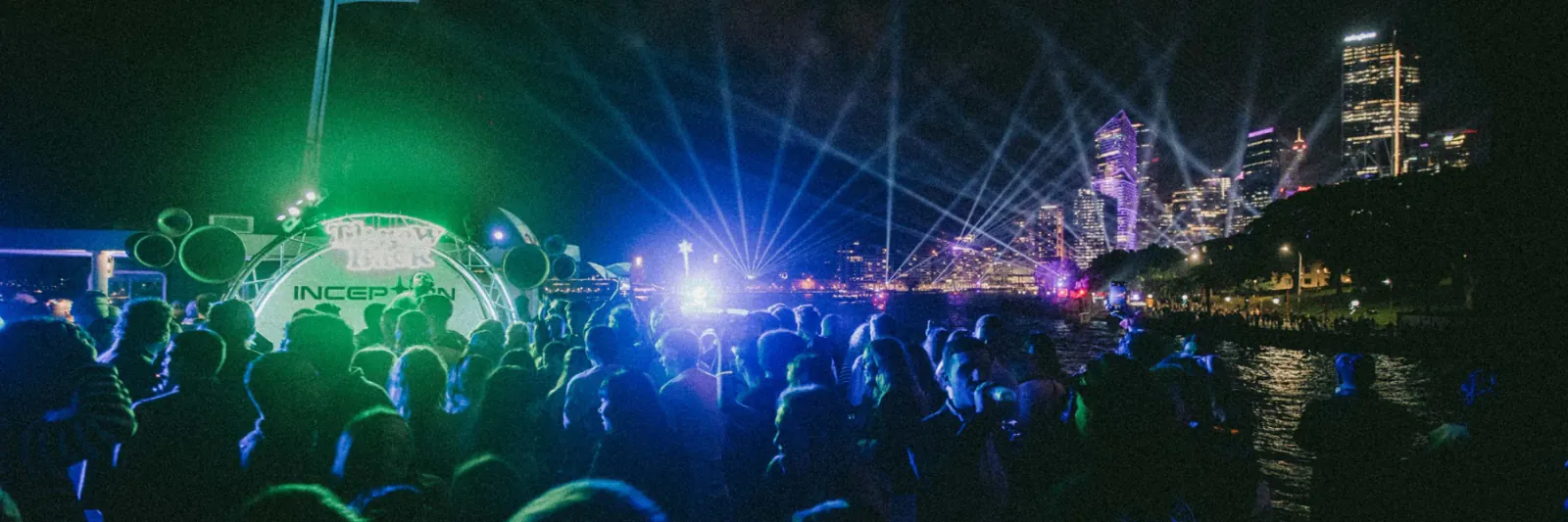
Start with a pre-registration campaign, not an announcement.
Before you have anything concrete to announce, set up a pre-registration form. Not a ticket sale, just an expression of interest page that captures a name, email, phone number, and location, plus optionally a qualifying question like “What kind of events do you usually go to?” or “Who is your favourite artist?”
This serves two purposes. First, it builds a first-party contact list you actually own. Unlike a social following, this data sits in your CRM and can be used to communicate directly with your audience via SMS and email whenever you want, with no algorithm deciding who sees it. Second, it creates a sense of selective access. People who sign up feel they are getting in early on something others do not know about yet, which is a genuinely powerful feeling when the event eventually goes live.
Keep the page minimal. Your branding, a single line of copy about what you are building, and a form. That is all. Elaborate pages with full lineups and pricing at this stage usually do not convert better than a simple teaser.
On yourkind, every form respondent is automatically added to your database with a label, so when tickets go live you can send a targeted SMS or email campaign to just those people in a few clicks.
Document the process, not just the product.
Content about the event itself is hard to produce before the event exists. Content about the process of building it is unlimited. Show people what it looks like to scout a venue, negotiate with suppliers, brief a visual artist, or build a setlist. This type of content builds a connection with the brand that is hard to replicate once you are in full production mode.
Short-form video is the most efficient format for this. A 30-second clip of a venue walkthrough or a brief snippet of a sound system test will reach more people and generate more genuine interest than a designed graphic announcing a date. Do not overthink the production quality. Authenticity outperforms polish at this stage.
Use your existing network as the first amplifier.
Every first event sells most of its tickets to the organiser’s existing network. This is not something to be embarrassed about. It is the natural first step. The question is how to turn that first network into a broader one.
Be direct with people in your network. “We are building something and we want you involved early. If you share the pre-registration link with one person who you genuinely think would love this, it helps us more than anything else.” Personalised asks generate far more responses than broadcast posts. Send them individually where you can.
Why first-party data matters more than followers.
Social platforms change their algorithms, reduce organic reach, and occasionally disappear entirely. A database of people who have opted in to hear from you is a direct, owned channel that no platform can take away. This is first-party data, and it is the single most valuable asset you can build as an event organiser.
When someone fills out a pre-registration form, you capture their name, email, phone number, and location. That is enough to segment your audience by city, send them an SMS when tickets drop, follow up with an email campaign a few days later, and keep them engaged between events. You are not renting access to your audience from Meta or TikTok. You own the relationship.
Prioritise growing your database above any vanity metric. 50 people in your CRM who you can message directly are worth more than 5,000 followers you cannot reach.
The milestone moment.
At some point, ideally three to four weeks before your on-sale date, give your pre-registered list first access to tickets before they go public. Frame it clearly: “You signed up early, so you get 48 hours before anyone else.” This is the payoff for the community you have been building, and it creates a social event in itself. People who got early access will tell people who did not.
The goal is not to sell out in 48 hours from the pre-reg list alone, although that does happen. The goal is to create a launch with genuine momentum, a visible sense that something desirable is happening, so that when general sales open you have social proof working for you rather than starting from zero.
Keep them coming back.
The real value of building an audience before your first event is not just selling tickets to one show. It is building a database that grows with every event you run. Every ticket buyer, every form respondent, every person who interacts with your brand gets added to your CRM automatically. After your first event, you can collect reviews, send follow-up campaigns, and start building anticipation for the next one, all from the same platform. The organisers who sell out consistently are not starting from scratch every time. They are talking directly to an audience that already knows them.